
Emergency Tree Service St. Louis With 24/7 Storm Response
When a tree comes down on your roof, blocks your driveway, snaps across a fence line, or is leaning dangerously toward your home after a St. Louis storm — you do not have time for a form submission and a two-day callback. Call us directly. We are a locally owned emergency tree service company operating 24 hours a day, seven days a week, across St. Louis City, St. Louis County, Saint Charles County, and Jefferson County. A real person answers the phone. We assess your situation immediately and dispatch a crew as fast as conditions allow.
Emergency tree service in St. Louis is one of the most time-critical service calls a homeowner can make. The wrong decision — waiting, attempting to remove a tree yourself, or hiring the first company that answers — can turn a serious situation into a catastrophic one. Our ISA-certified arborists and trained emergency tree crews have the equipment, the insurance, and the experience to bring the situation under control safely.
What to Do Right Now — Safety First
If you are dealing with an active tree emergency in St. Louis, follow these steps before our crew arrives:
Stay away from the tree and any downed lines — A tree that has fallen on a power line or near utility infrastructure must be treated as energized and extremely dangerous until the utility company confirms otherwise. Do not go near it. Call Ameren Missouri (or your local utility) immediately if utility lines are involved — then call us.
Do not attempt to move or cut the tree yourself — A partially fallen or leaning tree is under enormous tension. Cutting it without understanding which direction that tension is loaded — and which direction it will release — can cause the tree to move violently and unpredictably. This is how serious injuries happen during storm cleanup. Leave it to a trained emergency tree crew.
Document the damage for your insurance claim — Before any work begins, take photographs of the tree position, any structural contact with your home or outbuilding, and the surrounding damage. These images are your primary evidence for an insurance claim and should be taken as soon as it is safe to do so.
Secure the interior if a tree has penetrated your roof or wall — If the tree has created an opening in your home's envelope, place buckets and move valuables away from the affected area. Do not enter an attic or upper floor directly beneath a tree resting on the roof structure — the load is unpredictable.
Call us. We will ask you the right questions, assess the urgency level, and give you an honest estimate of our response time based on current conditions and call volume.
Emergency Tree Service St. Louis When Every Minute Counts
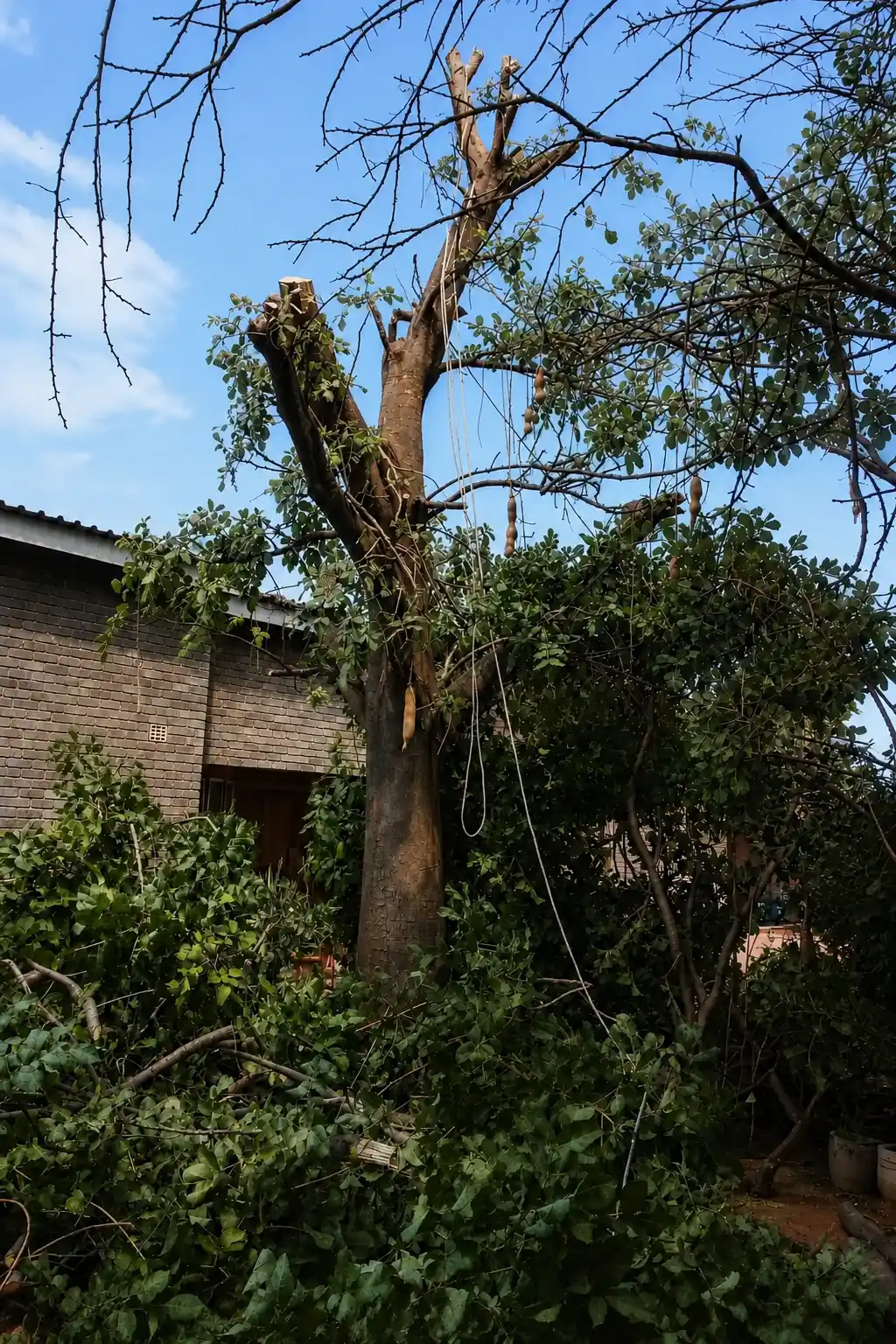
Our emergency tree service is not a side offering — it is a core part of how we operate across Greater St. Louis. We maintain a dedicated emergency response capacity year-round, with crew availability and equipment staged for rapid deployment across St. Louis City, St. Louis County, Saint Charles County, and surrounding communities.
For most emergency calls in St. Louis County and Saint Charles County during normal conditions, we aim to arrive within two to four hours of your call. During active major storm events — when call volume spikes across the region simultaneously — response times lengthen, and we will be honest with you about that when you call. Emergency calls where a tree is actively on a structure are always prioritized over standard cleanup situations.
What sets our emergency tree service apart from every form-only competitor: when you call our number, a person answers. We do not route emergency calls to voicemail or promise a callback within a business day. Tree emergencies do not follow business hours, and our response capability does not either.
What Qualifies as a Tree Emergency in St. Louis?
Not every tree situation requires emergency service — but the following situations do. If any of these describes your property, call immediately rather than waiting to submit a form or schedule a standard appointment.
A tree or large branch has fallen on your home, garage, fence, or vehicle — Any situation where a tree is in direct contact with a structure requires immediate professional response. The weight distribution and tension in a partially supported fallen tree is unpredictable, and the structural load on your roof or wall changes as the tree settles.
A tree is leaning or shifting after a storm —A tree that was upright before a storm and is now visibly leaning, or one where you can see the root ball beginning to lift on one side, is at immediate risk of full failure. Unstable trees in this condition can topple without warning.
A large branch is hanging or suspended in the canopy —Widow-makers — branches that have partially broken but are caught in the canopy rather than falling to the ground — are among the most dangerous situations in emergency tree service. They can release without warning, triggered by wind, additional rain, or even the vibration of someone walking near the tree.
A tree is threatening power lines — Any tree or branch that has made contact with, or is at imminent risk of contacting, overhead utility lines is a utility and emergency tree service situation simultaneously. Call Ameren Missouri or your local utility company and us at the same time.
A tree is blocking a road, driveway, or emergency access —A fallen tree blocking access to your property or a roadway creates a safety and access issue that qualifies for priority response.
Visible structural damage to the trunk or main scaffold —Significant splitting at a major branch union, a large wound exposing the interior wood of a trunk, or visible decay at the base of a tree in a high-risk location all warrant an emergency arborist consultation even if the tree has not yet fallen.
St. Louis Severe Weather and Tree Emergencies
St. Louis, Missouri sits in one of the most severe weather corridors in the country. Understanding why emergency tree service calls spike the way they do in Greater St. Louis helps homeowners prepare — and respond — more effectively.
Derechos and straight-line wind events — St. Louis experiences some of the most damaging derecho events in the Midwest, with straight-line winds regularly reaching 70 to 90 miles per hour across the metro area. These events can cause mass tree failure across entire neighborhoods in minutes, generating hundreds of simultaneous emergency tree service calls. After a major derecho event, response times for all tree service companies in St. Louis increase significantly as demand spikes region-wide.
Spring and summer severe thunderstorms — Supercell thunderstorms crossing the St. Louis area frequently produce damaging wind gusts, large hail, and lightning strikes that split, topple, or heavily damage trees across St. Louis City and County. The highest volume of emergency tree service calls in the St. Louis area comes in the April through August severe weather season.
Ice storms — Missouri ice storms coat branches with heavy ice accumulation that dramatically increases canopy weight, causing widespread limb failure and full tree collapse — particularly in silver maples, Bradford pears, and older elms that are common throughout the Greater St. Louis urban forest. Ice storm tree damage often occurs overnight and is discovered at dawn, creating a surge of emergency calls.
Tornadoes — St. Louis sits on the edge of Tornado Alley and has experienced direct and nearby tornado strikes in recorded history. Tornado-related tree damage produces the most catastrophic individual property situations, often involving multiple large trees and structural damage to homes requiring coordinated emergency response.
Regular tree maintenance and professional tree pruning is the most effective strategy for reducing your property's emergency tree service exposure. Properly maintained trees with good structure and regular deadwood removal consistently suffer less storm damage than neglected trees.
Our Emergency Tree Removal Process in St. Louis
When our emergency tree crew arrives at your St. Louis property, here is what happens:
Immediate site assessment
Before any cutting begins, our arborist assesses the full situation: tree position, contact points with structures, tension loading in the trunk and major limbs, proximity to utility lines, access routes for equipment, and the safest sequence for removal. This is not a formality — it is how we prevent a serious situation from becoming a catastrophic one.
Stabilization if possible
For leaning or unstable trees not yet in contact with a structure, we evaluate whether immediate controlled stabilization can reduce urgency. In some cases, tree cabling and temporary bracing can buy time for a safer, planned removal rather than a rushed emergency extraction.
Controlled sectional removal
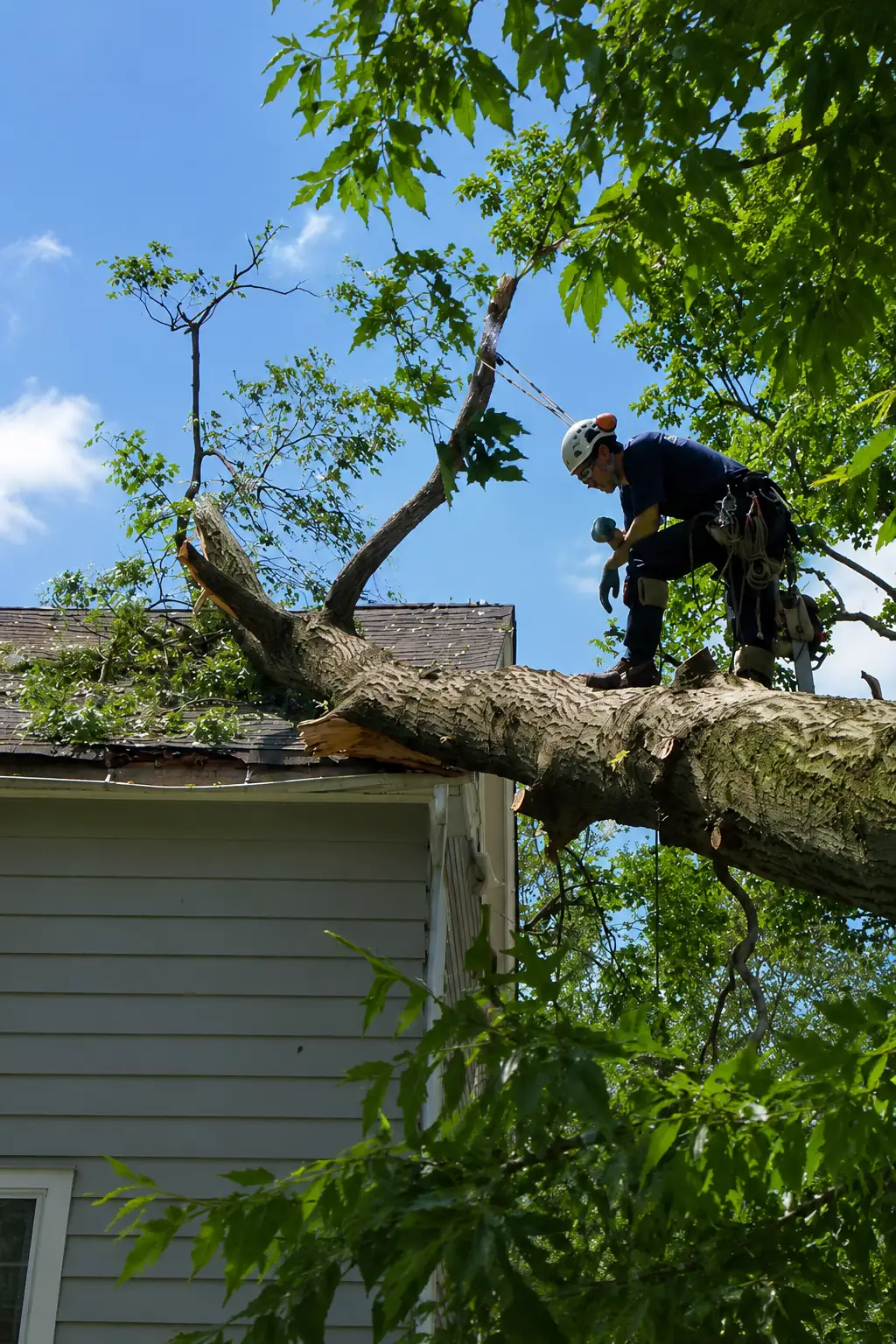
For trees in contact with structures or in confined locations, we remove the tree in sections from the top down using climbing techniques and rigging systems that control where each section falls. This prevents additional impact loading on a roof or structure already under stress. For larger situations, we deploy crane equipment for zero-impact controlled lifts.
Tarp and temporary protection
If your roof or structure has been breached, we can tarp the exposed area after the tree is removed to protect the interior from weather while permanent repairs are arranged. This is a common component of emergency tree service in St. Louis following storm events.
Debris management
All cut wood and brush is cleared from the immediate hazard area as a priority. Full site cleanup is completed as conditions and safety allow. We haul all debris away — you will not be left with a pile of logs and brush in your yard after an emergency.
Emergency Tree Removal and Your Homeowner's Insurance
One of the most frequently asked questions we receive after a tree emergency in St. Louis is whether homeowner's insurance covers the removal cost. The answer depends on several factors that are worth understanding before your claim.
When insurance typically covers tree removal — Most homeowner's policies in Missouri cover emergency tree removal when a tree falls due to a covered peril (wind, lightning, ice storm) AND causes damage to a covered structure such as your home, garage, fence, or deck. In these situations, the cost of removing the tree from the structure — and often a portion of general cleanup — is typically covered subject to your deductible.
When insurance typically does not cover tree removal — If a tree falls in your yard but does not land on a covered structure — even if it blocks your driveway or damages landscaping — many standard homeowner's policies do not cover the removal cost. Similarly, tree removal that is elective (you want a healthy tree removed) is virtually never a covered insurance event.
What we provide to support your insurance claim — We document the emergency situation with photographs before work begins, provide a detailed written invoice specifying the scope and cost of emergency tree service performed, and can provide documentation of tree condition as assessed by our arborists. This documentation is what your insurer will request when processing your claim.
Our recommendation — Call your insurance company at the same time you call us. Report the event, get a claim number, and ask what documentation they require. Do not wait to report — most policies have specific timeframes for storm damage claims. We will work alongside your timeline.
After the Emergency — Post-Storm Tree Risk Assessment
One of the most important — and most overlooked — steps after a St. Louis storm event is having the trees that did NOT fall professionally assessed. A tree that appears undamaged from the ground may have significant internal structural compromise from storm loading: root zone disturbance, hidden crown failures, split unions partially held together by bark alone, or trunk compression damage at the base.
Our ISA-certified arborists provide post-storm tree risk assessments across Greater St. Louis following major weather events. These assessments evaluate:
Visible structural indicators — New cracks, splits, or separations at major branch unions; tilting or crown shift; soil heaving or cracking at the root zone; leaning that was not present before the storm.
Canopy condition — Proportion of crown loss; deadwood exposure; branches hanging or suspended in the canopy (widow-makers) that are not visible from the ground.
Root zone integrity — Evidence of root zone disruption, particularly on trees in saturated soils common after heavy St. Louis rainfall events, which significantly increase toppling risk even for apparently healthy trees.
Written risk assessment documentation — For situations involving insurance claims, permit applications, neighbor disputes, or property sales, we can provide a written professional arborist tree risk assessment that documents our findings and recommendations.
Post-storm arborist consultations are available across all of Greater St. Louis and are strongly recommended any time a major storm event has affected your neighborhood — even if your trees appear intact.
Can a Damaged Tree Be Saved? Tree Cabling After Storm Damage
Not every damaged tree in St. Louis needs emergency tree removal. For trees that have suffered partial crown damage, split at a co-dominant stem, or developed a structural deficiency that has not yet led to failure, tree cabling and bracing can be a legitimate alternative to removal — provided the structural situation is assessed honestly by a certified arborist.
Tree cabling installs high-strength steel or synthetic cable systems between major scaffold branches to redistribute canopy load, limit the range of limb movement in wind events, and prevent further separation at a compromised union. Combined with targeted crown reduction to remove end-weight from overextended limbs, cabling can significantly extend the functional life of a damaged tree that has landscape value and sound interior structure.
Our arborists assess every damaged tree situation with an open mind to both options — removal and preservation. We will never recommend emergency tree removal when cabling and proper pruning can safely address the risk. We will also never recommend cabling a tree that has passed the point where it can be made safe. Honest recommendations, always.
Residential & Commercial Emergency Tree Service in St. Louis
We provide emergency tree service for both residential homeowners and commercial property clients throughout the St. Louis metro area. Residential emergency calls — trees on homes, garages, and fences across St. Louis City and County — represent the majority of our emergency work. We understand the stress of a tree emergency at your home and prioritize clear communication throughout the process.
For commercial tree service emergencies — property managers, shopping centers, HOAs, schools, churches, and office parks across Greater St. Louis and Saint Charles County — we provide the same 24/7 emergency response with the commercial liability coverage, documentation, and professional process your facility management team requires. We maintain certificates of insurance for commercial emergency engagements and work within your emergency vendor protocols.
Emergency Tree Service FAQs — St. Louis, MO
How fast can you respond to an emergency tree call in St. Louis?
For most emergency tree situations in St. Louis County and Saint Charles County under normal weather conditions, we aim to arrive within two to four hours of your call. Active storm conditions — when we are responding to multiple simultaneous emergencies across Greater St. Louis — extend response times, and we will give you an honest estimate when you call. Situations where a tree is actively on a structure are always dispatched ahead of standard cleanup requests. Call us directly; do not submit a web form during an active emergency.
Is emergency tree removal covered by my homeowner's insurance in St. Louis?
In most cases, yes — if a tree fell due to a covered weather event and landed on a covered structure such as your home, fence, or garage. If a tree fell in your yard without hitting a structure, coverage is less common. We recommend calling your insurer simultaneously with calling us, reporting the event immediately, and requesting documentation requirements. We provide written invoices and pre-work photographs to support your insurance claim.
Can you remove a tree that fell on my roof without causing additional damage?
Yes. Removing a tree from a structure is one of the most technically demanding aspects of emergency tree service, and it is where the difference between a trained professional crew and an untrained one is most consequential. We remove trees from structures using section-by-section rigging that controls exactly where each piece of wood goes — preventing additional impact loading on a roof or wall already under stress. We also offer tarp installation after removal to protect your home's interior while roofing repairs are arranged.
What should I do if a tree falls on a power line in St. Louis?
Call Ameren Missouri (1-800-552-7583) or 911 immediately and then call us. Do not approach a tree that has made contact with a power line or that has downed a line — treat all downed lines as energized and lethal regardless of their appearance. Our emergency tree crew coordinates with utility personnel and will not begin work near power lines until the utility company has confirmed the safety status of the lines involved.
Do you charge more for emergency tree service in St. Louis?
Emergency tree service in St. Louis typically carries a premium over standard scheduled work — this reflects the costs of maintaining 24/7 availability, emergency equipment readiness, and after-hours crew dispatch. We provide honest, upfront pricing before work begins. For situations covered by homeowner's insurance, emergency service costs are typically submitted as part of the claim. For situations not covered by insurance, we work with homeowners on clear written estimates. We will never take advantage of a storm situation to inflate pricing.
A tree in my yard looks fine but is leaning slightly after the storm. Should I be worried?
Yes — take it seriously. A tree that has developed a new lean following a storm event may have root zone disturbance or internal structural compromise that is not visible from the ground. Trees in this condition can fail days or weeks after the storm that weakened them. Contact us for a post-storm tree risk assessment. Our arborists will evaluate the tree, document their findings, and give you an honest recommendation on whether monitoring, cabling, or tree removal is the appropriate response.
Tree Emergency in St. Louis? Call Now — We Answer 24/7.
Do not submit a form during an active tree emergency. Call us directly.
📞 (314) 408-6696 — 24 Hours · 7 Days · No Answering Machine
If you are not in an active emergency and want to schedule a consultation, post-storm tree risk assessment, or preventive tree care service, use the form below:
Our emergency tree service covers: St. Louis City · St. Louis County · Saint Charles County · Jefferson County · Webster Groves · Kirkwood · Clayton · Ladue · Chesterfield · Creve Coeur · Maplewood · Brentwood · Maryland Heights · Bridgeton · Hazelwood · Florissant · O'Fallon · St. Charles · St. Peters · and all surrounding Greater St. Louis communities.
RELATED SERVICES:
Fast Response — We Reply in Under 2 Hours
Get Your Free Estimate Today
Your information is 100% safe and never shared.