
Tree Cabling & Bracing
Tree Cabling and Bracing for Structurally Compromised Trees
Some of the most valuable trees on a St. Louis property are also the most structurally vulnerable. A century-old white oak with a co-dominant stem split growing over a backyard in Ladue. A beloved silver maple that has shaded a Webster Groves home for sixty years but has developed heavy, overextended limbs. A mature ash tree that survived Emerald Ash Borer treatment but carries visible structural weakness at a major scaffold union. These are the trees that define a property — and in many cases, professional tree cabling and bracing can save them when tree removal would otherwise seem to be the only option.
We provide ISA-certified tree cabling and bracing services throughout St. Louis City, St. Louis County, Saint Charles County, and Jefferson County. Our arborists assess every structurally compromised tree individually, recommend the appropriate tree support system, and install it to ANSI A300 standards — the benchmark for professional tree support hardware in the industry.
ISA-Certified Arborists
ANSI A300 Standards
Fully Insured
Free Estimates
What Is Tree Cabling and Bracing?
Tree cabling and bracing are the two primary forms of structural support installed by professional arborists to reduce the risk of tree failure in trees with identified structural weaknesses. They address different types of structural problems and use different hardware — but they are often used together as a complementary tree support system on the same tree.
Tree Cabling
Tree cabling uses high-strength steel or synthetic cable installed between two or more major scaffold limbs or stem unions to limit the range of movement between those limbs during wind, ice, and storm loading. Cables are typically installed in the upper third of the canopy, anchored through eye bolts that are threaded into the wood of each supported limb. The cable runs between the eye bolts in a near-horizontal configuration, creating a tension connection that prevents the supported limbs from separating beyond a defined range.
Two primary cabling systems exist in professional tree care:
Static cabling uses a fixed, non-elastic steel cable that limits movement to a hard stop. It is appropriate for trees where movement between the supported stems must be strictly controlled — particularly in cases where there is active bark inclusion at the union and any significant movement could accelerate splitting.
Dynamic cabling uses elastic, high-strength synthetic cable systems (such as Cobra or similar products) that allow a controlled degree of natural movement while still redistributing the load during extreme events. Dynamic systems are preferred by many ISA-certified arborists for trees in otherwise good health with moderate structural defects, as they allow the tree to continue developing some natural wood reinforcement through normal wind movement.
Tree Bracing
Tree bracing addresses cracked trunks, split branch unions, and co-dominant stems that have already begun to separate. Where cabling controls movement from above, bracing provides rigid support at the point of failure itself. Bracing is installed by drilling through the trunk or union and inserting a threaded steel rod — which is then secured with washers and nuts on each side, drawing the split tissue back together and preventing further separation.
Bracing is most commonly used alongside cabling, not independently. The brace stabilizes the immediate failure point; the cable above limits the dynamic loading that would otherwise stress the brace over time.
Bolting
For older or very large trees with significant cracks, splits, or decayed wood at major branch unions, supplemental bolting installs additional steel rods through the affected area to provide reinforcement at multiple points. Bolting is appropriate when a single brace rod is insufficient for the mass of wood being supported.
When Does a Tree in St. Louis Need Cabling or Bracing?
Our ISA-certified arborists assess each tree for specific structural indicators that determine whether cabling, bracing, or a combination of both is the right intervention. The most common conditions we address across Greater St. Louis:
Co-dominant stems with included bark — This is the most frequent structural problem we cable in St. Louis trees. Co-dominant stems occur when a tree develops two or more roughly equal-sized upright stems from the same point on the trunk, rather than a single central leader. When those stems grow together, their bark folds inward at the union — creating included bark — rather than forming the interlocking wood fibers of a healthy union. Included bark unions are fundamentally weak. Under ice or wind loading, they split. Tree cabling above a co-dominant stem union dramatically reduces the probability of failure by limiting the separation force those stems can exert on each other.
Heavy, overextended limbs — Large horizontal limbs common on mature silver maple, oak, and hackberry trees across St. Louis County develop enormous end-weight over decades. As these limbs extend further from the trunk, the lever force applied at the union increases with every pound of wood added. Cabling these limbs back to a higher scaffold branch or to the trunk redistributes the load and reduces the failure risk — without the disfigurement of aggressive crown reduction.
Previous storm damage — Trees that have survived a split at a major union — held together by a strip of remaining bark and wood — are prime cabling and bracing candidates. The wood at the split point is weakened, but if the tree's overall structural integrity is sound, a properly installed brace rod and cabling system can maintain the tree safely for many years. Our arborists assess whether the remaining wood is sufficient to support the hardware load before recommending this approach.
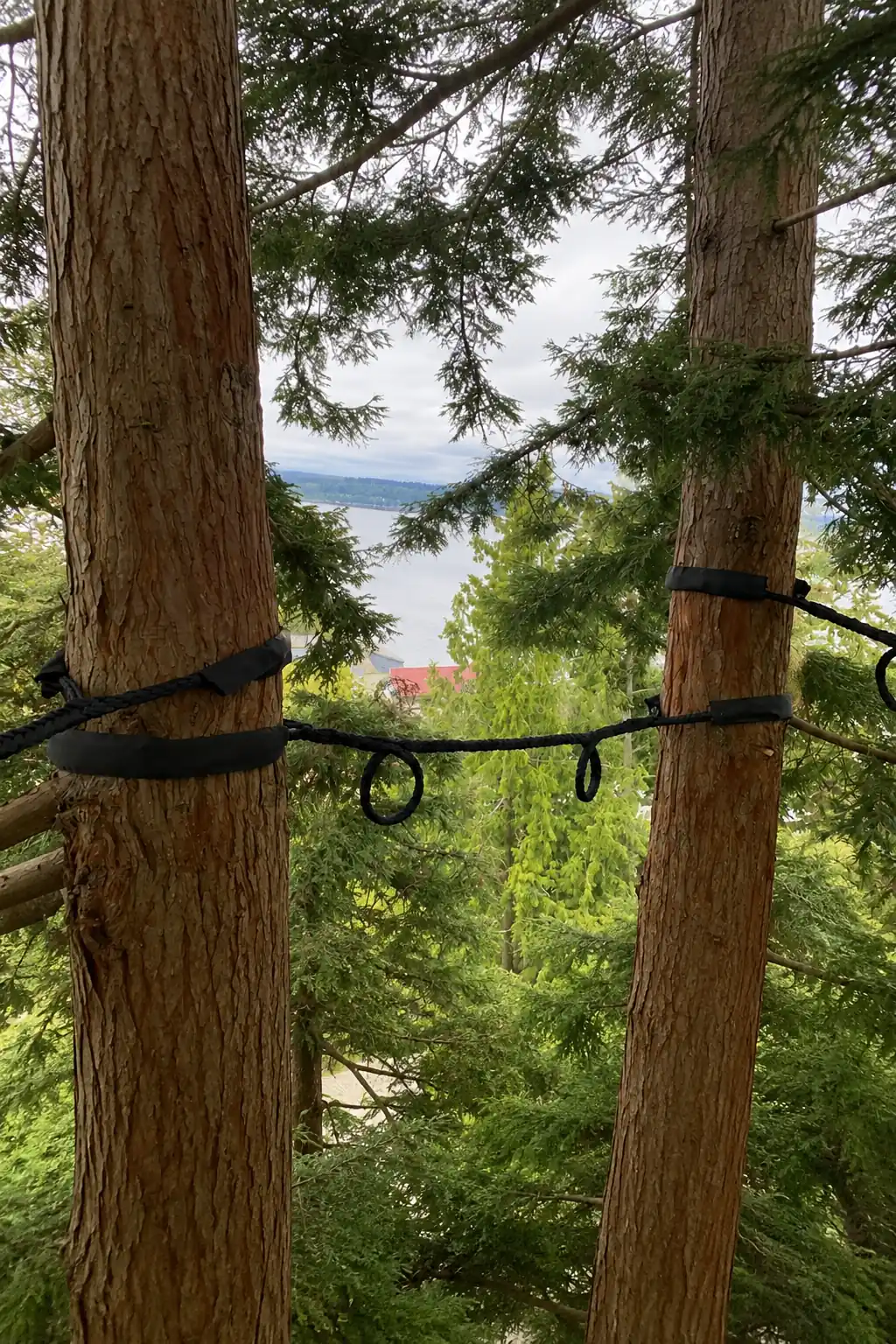
Weak branch unions — Branches attached at narrow angles (called narrow-angle or V-shaped unions) are inherently more prone to failure than branches attached at wider angles because less interlocking wood fiber forms across the union. Species with naturally narrow branch attachment angles — including Bradford pear, silver maple, and some elm varieties common across the St. Louis area — benefit significantly from preventive cabling before a failure occurs.
Large canopy on a mature or aging tree — As trees age, their capacity to compartmentalize damage and respond to structural stress declines. A mature tree with a large, heavy canopy may warrant cabling not because of a single identifiable defect, but because its overall canopy mass relative to its trunk taper and root zone condition creates a risk profile that cabling can help manage.
St. Louis Tree Species That Most Commonly Require Cabling
Not all trees are equally prone to the structural defects that cabling and bracing address. Our arborists encounter certain species repeatedly across Greater St. Louis when assessing trees for structural support:
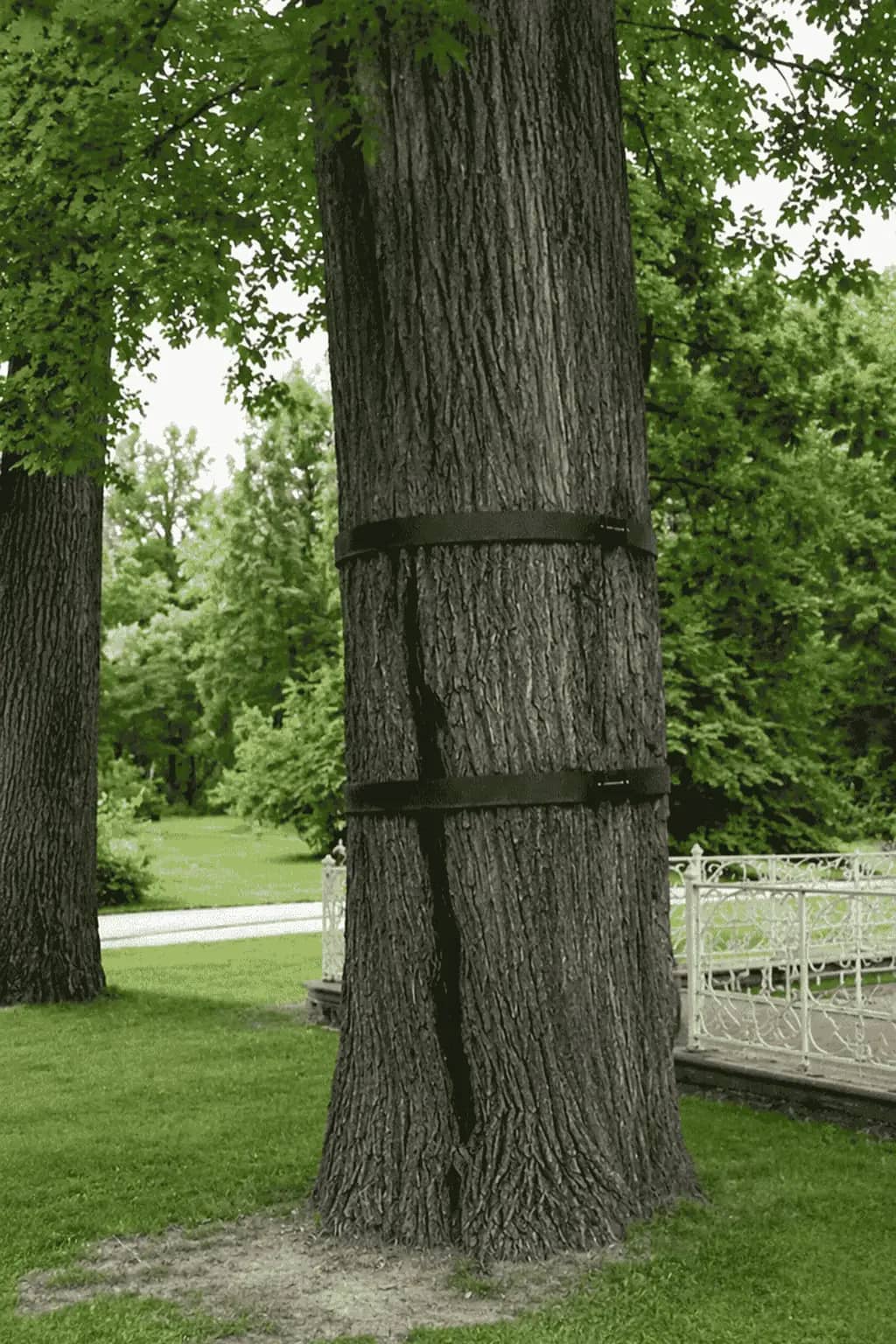
Silver maple — The most cabling-prone species we work with across St. Louis City and County. Silver maples grow fast, develop wide-spreading canopies quickly, and frequently produce co-dominant stems and overextended horizontal limbs that become failure points in ice storms and high-wind events. Many silver maples across St. Louis neighborhoods are strong cabling candidates by the time they reach thirty years of age.
Bradford and Callery pear — The standard variety has notoriously narrow branch attachment angles throughout the canopy. These trees split catastrophically in St. Louis ice storms, often losing half their canopy in a single event. Young to mid-age Bradford pears can be managed with structural pruning and cabling; mature specimens with advanced included bark require honest assessment about whether cabling is still a viable long-term option or whether planned tree removal is safer.
Hackberry — Common throughout St. Louis, hackberry trees frequently develop multiple co-dominant stems and internal decay that is not visible from the ground. ISA arborist assessment is particularly important for hackberry before cabling is installed, as internal decay changes the load-bearing capacity of the hardware anchoring points.
White and bur oak — The most valuable landscape trees in St. Louis, oaks occasionally develop co-dominant leaders and overextended scaffold branches as they mature. Tree cabling on a large, well-established oak is one of the highest return investments available in professional tree care — preserving a tree that took a century to develop.
American elm — Remaining elms in St. Louis — many of which have been managed through Dutch Elm Disease programs — are valuable heritage trees worth structural investment. Older elms sometimes develop significant crown mass with aging root systems that benefit from canopy load reduction through crown thinning combined with cabling.
Cabling Always Works With Pruning — Not Instead of It
One of the most important points our arborists communicate on every cabling assessment is this: tree cabling and bracing are most effective when combined with targeted crown pruning — not used as a substitute for it.
ANSI A300 standards for tree support systems include a complementary pruning requirement for good reason. Installing cable to support a heavy overextended limb while leaving the full end-weight on that limb places the entire structural load on the cable hardware. Reducing the end-weight through proper crown reduction pruning before or at the time of cabling installation reduces the load on the cable system, reduces the load on the anchoring eye bolts, and allows the supported tree to benefit from both interventions simultaneously.
In practice: when our arborists install a tree cabling system on a St. Louis property, they typically recommend — and often perform on the same visit — targeted weight reduction pruning on the supported limbs. This combination produces a structurally sound result that is more durable and requires less maintenance than cabling alone.
The Cabling & Bracing Installation Process in St. Louis
Every tree cabling and bracing installation we perform follows a consistent, ANSI A300-compliant process from assessment through installation.
Arborist assessment
Before any hardware is specified or ordered, our ISA-certified arborist evaluates the tree in full: structural condition, species, canopy mass, root zone health, identified defects, and the specific loading conditions the tree faces on your St. Louis property. This assessment determines whether cabling is appropriate, which system type (static or dynamic) is indicated, and where anchor points should be placed.
Hardware specification
Based on the arborist assessment, we specify cable diameter, eye bolt size, and rod specifications appropriate for the tree's mass and the structural problem being addressed. Hardware is specified to support the calculated load — not chosen based on what is cheapest or most available.
Anchor point installation
Eye bolts are installed at the correct height and orientation in each supported limb — typically in the upper third of the canopy for cabling. Brace rods are drilled through the union or trunk at the identified failure point. All hardware is installed to proper torque and alignment specifications.
Cable or rod installation and tensioning
Cable is run between anchor points and tensioned to the specified level — enough to provide support under load, but not so tight that it restricts the natural movement that contributes to wood development.
Complementary pruning
Weight reduction on the supported limbs is performed at the time of installation where indicated.
Documentation and inspection schedule
We document the installation with photographs and provide written recommendations for follow-up inspection intervals. Cabling systems require periodic inspection — typically every two to three years — to assess hardware condition, cable tension, and the continued effectiveness of the system as the tree grows.
Ongoing Maintenance — Inspection Matters
A tree cabling and bracing system is not a permanent, install-and-forget solution. Trees grow. Hardware does not. As the tree adds girth at the anchor points, the eye bolts and cable geometry change. Over years, improperly maintained systems can become ineffective — or worse, create new points of stress as the tree grows around hardware that is no longer correctly positioned.
Our arborists recommend inspection of all installed cabling and bracing systems every two to three years for most species under St. Louis conditions. Inspections assess cable condition and tension, eye bolt position and embedment, brace rod integrity, and the overall structural status of the supported union or limb.
Trees that have been cabled also need continued monitoring for the development of new structural defects elsewhere in the canopy. A supported co-dominant stem may remain stable — but the rest of the tree continues to grow and change. Annual or biennial arborist assessments are the most effective way to stay ahead of developing problems in any mature tree you have invested in preserving.
Tree Cabling Cost in St. Louis, MO
Tree cabling and bracing in St. Louis typically costs between $300 and $1,500 per tree depending on system complexity, tree size, and the scope of installation. What drives the cost:
Number of cable installations — A single cable run between two co-dominant stems on a mid-size maple costs significantly less than a multi-cable system on a large oak canopy with several overextended scaffold limbs.
Hardware specification — Static and dynamic cabling systems differ in material cost. Larger-diameter cables and larger eye bolts required for bigger trees increase material costs. Bracing rods are priced by size and number of installations.
Tree access and height — Taller trees require extended bucket truck access or technical climbing to reach the correct anchor point height in the upper canopy. Access complexity affects labor time and equipment cost.
Complementary pruning scope — If crown reduction pruning is recommended alongside the cabling installation — and it frequently is — the combined cost reflects both scopes of work. Scheduling both on the same visit is the most cost-efficient approach.
We provide free, written estimates on all tree cabling and bracing assessments across Greater St. Louis. An on-site arborist evaluation is required before any cost can be accurately quoted — cabling is a precision service that cannot be priced from a description alone.
Tree Cabling & Bracing FAQs — St. Louis, MO
Can cabling save a tree that has already started splitting in St. Louis?
In many cases, yes — provided the split has not progressed to the point where insufficient sound wood remains at the union to anchor the hardware and support the load above. Our ISA-certified arborists assess the remaining wood at the split point, the overall structural integrity of the tree, and the practical load the tree support system would need to manage. For trees where a split is caught relatively early and the interior wood is largely sound, a combination of brace rod installation and cabling above can stabilize the union effectively. For trees where the split has advanced significantly or where internal decay is present at the failure point, we will give you an honest assessment of whether cabling is still viable or whether tree removal is the safer answer.
What is the difference between static and dynamic tree cabling?
Static cabling uses a fixed steel cable that does not stretch, limiting movement between supported limbs to a hard mechanical stop. Dynamic cabling uses high-strength elastic synthetic cable (such as Cobra or similar systems) that allows controlled natural movement while redistributing extreme loads. Dynamic systems are generally preferred for younger trees in good health where some natural movement is beneficial to wood development. Static systems are indicated where the structural defect is advanced — particularly in active included bark situations where any significant movement accelerates separation. Our arborists specify the appropriate system for each tree based on the arborist assessment.
How long does a tree cabling system last in St. Louis?
High-quality steel and synthetic cabling systems are designed for long service life — typically ten to fifteen years or more when properly installed and maintained. The limiting factors are hardware corrosion (steel cables), UV degradation (synthetic dynamic systems), and the tree growing around or beyond the hardware anchor points. Regular inspection every two to three years allows us to assess system condition and re-tension or replace hardware before it fails. Well-maintained systems on structurally stable trees can provide effective support for decades.
Does tree cabling affect how the tree looks?
Minimally. Properly installed cabling runs in the upper canopy through hardware that is not visible from the ground in most cases. Eye bolts are small-diameter hardware anchored high in the tree — the cable itself is thin enough to be difficult to see against the sky. Bracing rods installed through a trunk or union are also not visible from normal viewing distance. The goal of professional cabling is to be structurally functional and visually unobtrusive. The most visible aspect of a cabling installation is typically the crown reduction pruning that accompanies it — which improves the tree's appearance and shape.
Should I cable my tree now or wait until after a storm damages it?
Before. Preventive tree cabling is significantly more effective and less costly than cabling installed after a storm has already caused a failure at the union. Once a co-dominant stem has split under storm loading, the remaining wood at the union is damaged and the structural situation is more complex to address. Cabling a tree with an identified structural weakness before a St. Louis storm event is the tree care equivalent of fixing a roof before it rains — the right time is always before the problem forces your hand. If your arborist has identified a structural defect in a tree on your property, schedule the installation before the next severe weather season.
Get a Free Tree Cabling & Bracing Assessment in St. Louis, MO
Ready to protect your valuable trees? Contact our St. Louis tree cabling and bracing team for a free, no-obligation assessment by an ISA-certified arborist. We evaluate the tree, explain exactly what we see, and give you a clear written estimate before any hardware is specified.
Or call us directly: (314) 408-6696
Serving: St. Louis City · St. Louis County · Saint Charles County · Jefferson County · Ladue · Clayton · Webster Groves · Kirkwood · Chesterfield · Creve Coeur · Des Peres · Town and Country · University City · Maplewood · Brentwood · and all Greater St. Louis communities.
RELATED SERVICES:
Fast Response - We Reply in Under 2 Hours
Get Your Free Estimate Today
Your information is 100% safe and never shared.