Tree Disease Treatment
Tree Disease Treatment by ISA-Certified Arborists
A tree that is losing leaves out of season. A sycamore whose canopy looks scorched from the inside out in April. An oak with browning branch tips that is spreading that brown further down the canopy each week. An elm that has turned yellow and wilted through an entire crown section with no obvious cause. These are the signs that bring St. Louis homeowners to our phone — and in many cases, what looks like the end of a tree is the beginning of a treatment plan that can save it.
We provide professional tree disease treatment and plant health care services throughout St. Louis City, St. Louis County, Saint Charles County, and Jefferson County. Our ISA-certified arborists diagnose tree disease accurately, distinguish disease problems from pest infestations and environmental stressors, and develop treatment programs calibrated to the specific disease, tree species, and conditions on your property. Not every diseased tree needs to come down — and the first step to knowing whether yours can be saved is an accurate diagnosis by an arborist who knows St. Louis trees.
ISA-Certified Arborists
Accurate Diagnosis First
Plant Health Care
Free Estimates
Tree Health Care and Tree Disease Treatment in St. Louis
Professional tree disease treatment sits within a broader category of tree care called plant health care — an integrated approach to maintaining the health of trees and shrubs over time through diagnosis, treatment, prevention, and environmental management. Our plant health care program in St. Louis is built around one principle: understand what is actually wrong before applying any treatment.
Many tree disease problems in St. Louis are misdiagnosed — sometimes by homeowners, sometimes by tree service companies that lack a plant health care background. A tree shedding leaves in June may have Anthracnose, or it may be responding to drought stress. An oak with browning branch tips may have Oak Wilt, or it may have Diplodia tip blight, or it may be responding to soil compaction around its root zone. These conditions look similar at a glance but require completely different treatment responses. Treating for the wrong thing wastes money and costs time the tree may not have.
Our certified arborists assess every tree systematically — visual inspection, symptom mapping across the canopy and bark, leaf and twig sampling where indicated, and soil assessment when root zone problems are suspected. When the diagnosis is clear, we prescribe the appropriate treatment. When it requires laboratory confirmation, we collect samples and return with a definitive answer before any treatment is recommended.
Tree Diseases in St. Louis, MO — What Our Arborists Treat
St. Louis, Missouri sits at a botanical crossroads — the climate supports both eastern hardwood forest species and Midwestern prairie-edge species, creating a diverse urban forest that also faces a wide range of fungal diseases, bacterial infections, and pest infestations. These are the most common tree disease problems our arborists treat across Greater St. Louis.
Dutch Elm Disease
Dutch Elm Disease is one of the most destructive tree diseases in the history of St. Louis. Caused by a fungal pathogen spread by elm bark beetles, Dutch Elm Disease blocks the vascular system of infected elm trees — cutting off water and nutrient transport from the roots to the crown. Symptoms include sudden wilting and yellowing of leaves on individual branches in the upper canopy, followed by browning and dieback that spreads rapidly if left untreated. Removing bark from an affected branch often reveals brown or olive streaking in the sapwood — the diagnostic indicator of vascular infection.
Treatment and management: Preventive trunk injection with systemic fungicide is the most effective tool available for protecting healthy elm trees in St. Louis from Dutch Elm Disease. For trees in early stages of infection, aggressive pruning of infected branches combined with injection therapy can interrupt disease progression and save the tree. For trees with infection in the root system or main trunk, treatment options are limited and tree removal is often the recommended outcome to prevent spread to neighboring elms through root grafts. Disease control requires a neighborhood-wide perspective — an untreated infected elm is a source of beetle and fungal spread to every healthy elm within range.
Oak Wilt
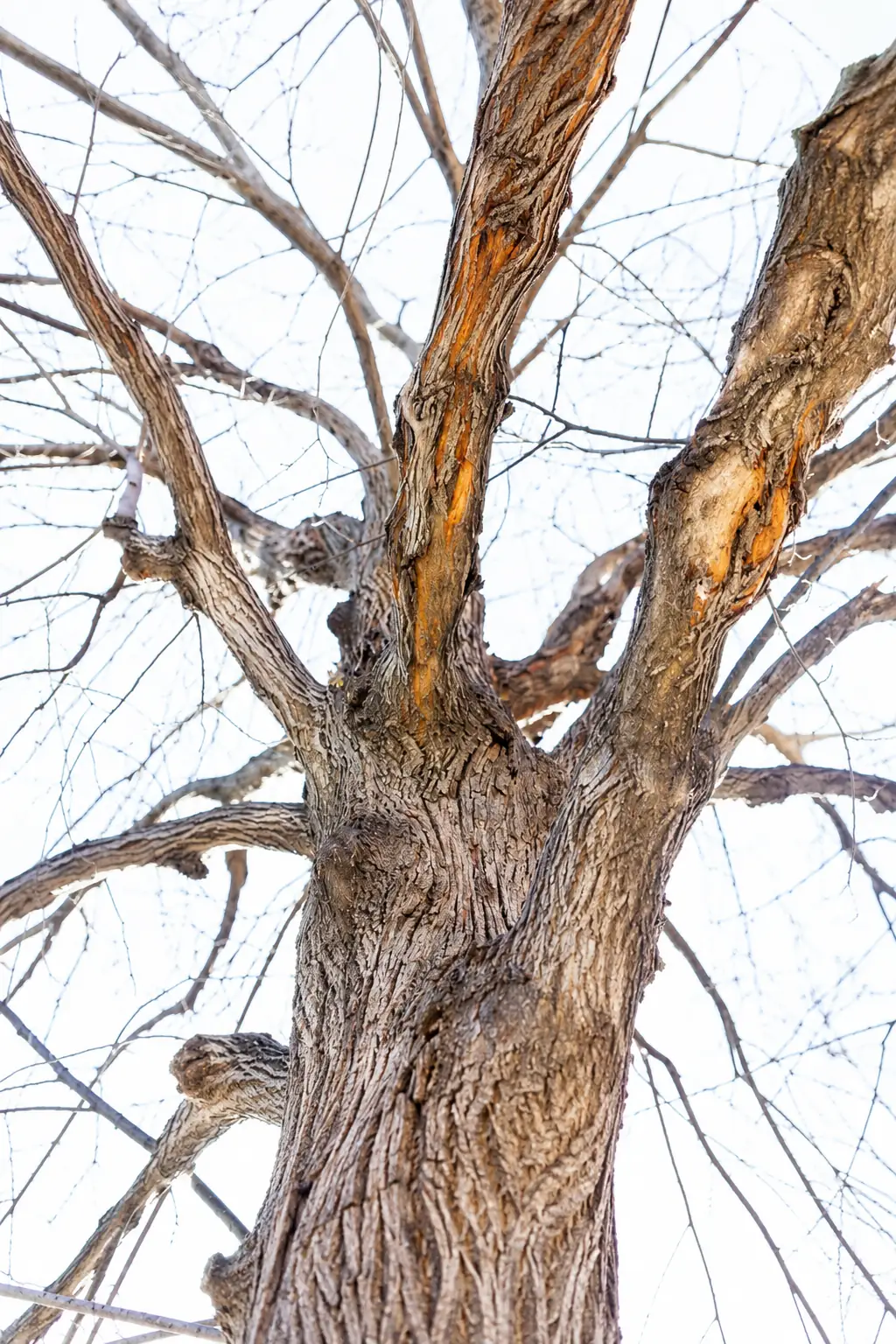
Oak Wilt is a vascular fungal disease that poses a particular threat to red oak species — including pin oak, Shumard oak, and scarlet oak — which are common throughout St. Louis County and Saint Charles County landscapes. Red oaks infected with Oak Wilt can die within weeks of symptom onset. White oaks are more resistant and decline more slowly, but are still vulnerable. Symptoms include wilting and browning of leaves beginning at the outer branch tips and progressing inward, leaf drop while still partially green, and vascular discoloration visible in cut sapwood.
The most critical disease control fact about Oak Wilt in St. Louis: do not prune red oaks from April through October. Fresh pruning wounds during the growing season attract the sap beetles that transmit the Oak Wilt fungus. Our arborists follow strict wound-timing protocols for all oak work in the Greater St. Louis area. For confirmed Oak Wilt infections, macro-infusion treatment with propiconazole is the most effective systemic intervention currently available for slowing disease progression in high-value red oaks. Root graft severance between infected and neighboring healthy oaks is also critical to preventing soil-level transmission.
Anthracnose
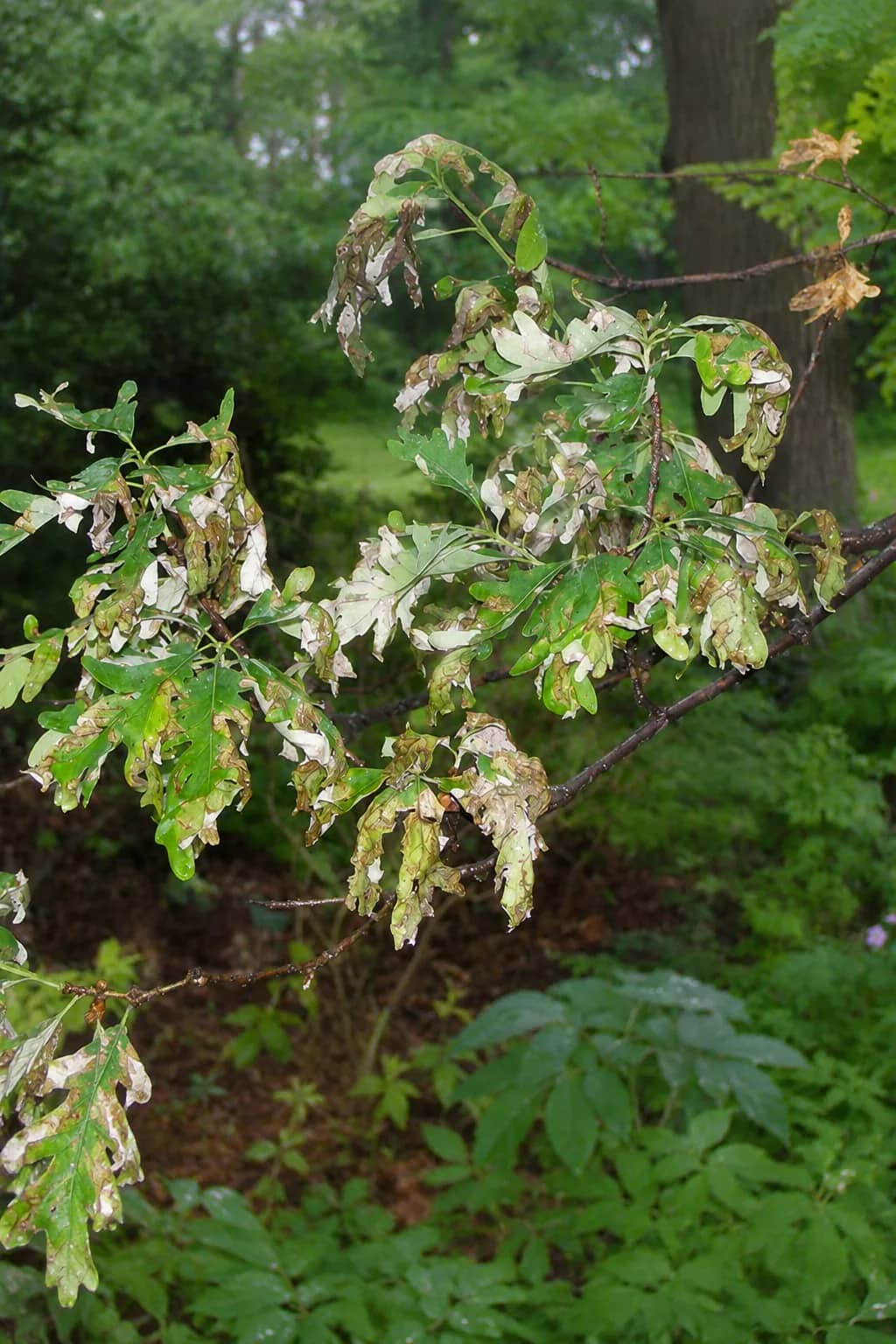
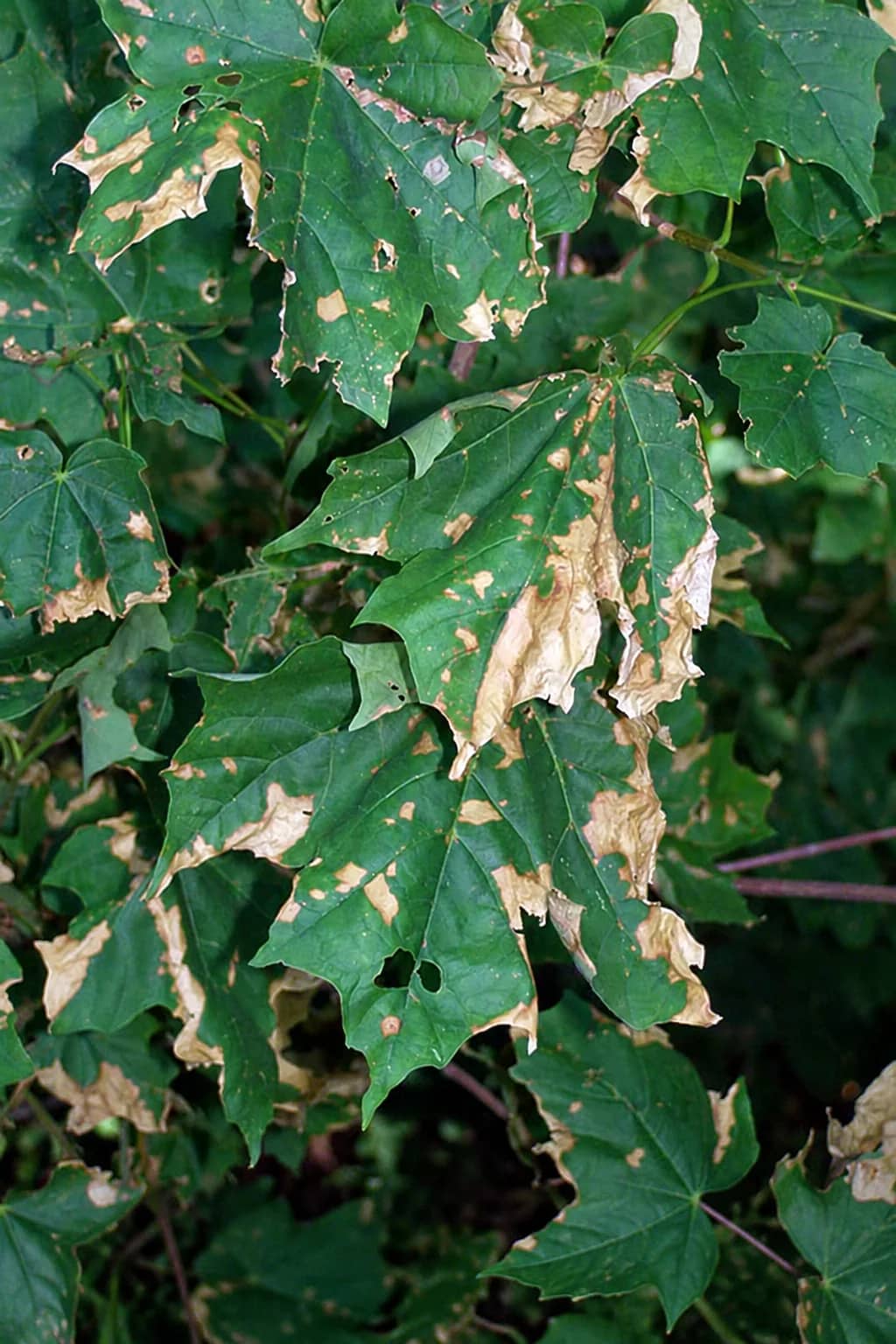
Anthracnose is the most widespread fungal disease in St. Louis trees and one of the most frequently misdiagnosed. It affects sycamore, white oak, maple, dogwood, ash, and walnut trees and produces symptoms that vary significantly by species and by the timing of infection relative to leaf emergence. In sycamores — the species most severely affected — early spring Anthracnose infection can cause complete defoliation within weeks of leaf-out, leaving the tree looking dead in May. In maples and oaks, Anthracnose produces irregular dark blotches and leaf distortion. In dogwoods, it causes leaf spots, cankers on twigs, and dieback.
The good news about Anthracnose: it rarely kills otherwise healthy trees directly. Most well-established trees recover and releaf within the same growing season after a severe spring infection. Treatment focuses on reducing disease pressure — fungicide applications timed to early leaf emergence in spring, removal and destruction of fallen infected leaf litter in autumn (which removes the overwintering source of fungal spores), and improving canopy air circulation through proper pruning. For trees experiencing repeated severe infection cycles, a scheduled spring fungicide program provides meaningful disease control and protects tree health over time.
Diplodia Tip Blight
Diplodia tip blight is a fungal disease of pine trees — particularly Austrian pine and Scots pine, which are common ornamental and screening trees throughout St. Louis County residential landscapes. It kills new shoot growth each spring, producing the characteristic "shepherd's crook" bend in current-year shoots with brown, stunted needles still attached. Severe annual infection progressively kills more of the tree's canopy from the bottom up over successive years.
Treatment involves fungicide applications timed to bud swell in early spring, before new shoot emergence, and repeated through shoot elongation. Pruning out infected twigs and branches improves disease management significantly. Trees with less than a third of their canopy affected respond well to a multi-year treatment program. Trees with advanced Diplodia dieback affecting the majority of the canopy are typically beyond economic treatment.
Fire Blight
Fire Blight is a bacterial disease — not a fungal disease — that targets apple, crabapple, pear, and serviceberry trees across St. Louis. It is caused by Erwinia amylovora and spreads rapidly under warm, humid spring conditions through blossoms, wounds, and water. Infected shoots turn brown and black, with the characteristic shepherd's crook bend at the tip that gives the disease its name — the affected branches look as if they have been scorched by fire. Fire Blight can devastate an ornamental crabapple's appearance within a single growing season.
Management includes aggressive pruning of infected wood at least eight to twelve inches below visible symptoms, with tool sterilization between cuts to prevent spread. Preventive copper bactericide applications timed to bloom are effective for high-value trees with a history of Fire Blight. Because it is bacterial rather than fungal, standard fungicide treatments are ineffective — accurate diagnosis is essential before treatment begins.
Oak Gall (Horned Oak Gall and Gouty Oak Gall)
Oak galls are one of the most common calls we receive from St. Louis homeowners worried about unusual growths on their oak trees. Horned Oak Gall and Gouty Oak Gall are caused by tiny cynipid wasps that lay eggs in oak twigs. The tree's response to larval development produces the distinctive woody galls that form on pin oak, shingle oak, and black oak branches across St. Louis County. A few galls on an otherwise healthy tree are primarily an aesthetic concern. Severe, multi-year infestations producing galls throughout the small-diameter twig system can cause significant dieback and weaken the tree's overall health, making it more vulnerable to secondary disease and pest infestation.
Oak gall treatment options are limited once galls are established. Pruning heavily galled branches and removing fallen galls reduces the local wasp population. Systemic insecticide injection during the active larval period provides some control in high-value trees with severe infestations. Our arborists assess each oak gall situation and give you an honest prognosis — in many cases, an otherwise healthy tree will manage the infestation without intervention beyond monitoring.
Root Rot
Root rot is one of the most frequently overlooked and misdiagnosed tree health problems in St. Louis — and one of the most important to address early because by the time symptoms are visible in the canopy, root system damage is typically already significant. Root rot in St. Louis trees is most commonly caused by Phytophthora, Armillaria (honey fungus), and Pythium species — water mold and fungal pathogens that thrive in poorly drained soils, compacted urban soils, and areas of chronic overwatering or standing water.
Symptoms include progressive dieback and thinning of the canopy from the top down (often confused with drought stress or vertical wilt diseases), premature autumn leaf color, stunted new growth, and in Armillaria infections, distinctive white mycelial fans under the bark at or just below the soil line and clusters of honey-colored mushrooms at the base of the tree in autumn.
Treatment begins with diagnosis — distinguishing root rot from drought stress, vascular disease, and nutrient deficiency requires an arborist assessment that includes soil evaluation and, in some cases, root collar excavation to examine the root system directly. Management approaches include improving soil drainage, reducing soil compaction around the root zone through vertical mulching or air spading, correcting overwatering practices, and in some cases applying targeted fungicide drenches to the root zone. Trees with advanced Armillaria infections and significant structural root loss require an honest assessment of whether the remaining root system can support the crown — and in some cases, tree removal is the safest outcome.
Tree Pest Infestations — When Disease and Insects Overlap
Tree disease and tree pest infestations are often connected. Stressed, diseased trees are more vulnerable to insect infestation; insect damage creates entry wounds that allow fungal and bacterial pathogens to colonize tissues that would otherwise resist infection. Our plant health care approach addresses both simultaneously through Integrated Pest Management.
Emerald Ash Borer (EAB) —The most economically significant tree pest currently affecting St. Louis County and the surrounding region. EAB is a wood-boring beetle whose larvae girdle ash trees under the bark, cutting off nutrient and water transport. Without preventive trunk injection treatment, virtually all untreated ash trees in infested areas eventually die. Preventive treatment with emamectin benzoate (systemic injection) or imidacloprid (soil drench or trunk injection) is highly effective when initiated before infestation or in the earliest stages of EAB activity. Our arborists can assess your ash trees and recommend a treatment timeline.
Bagworms — Bagworms construct distinctive silk-and-debris cases on arborvitae, juniper, spruce, and other conifers across St. Louis, defoliating affected trees when infestations are severe. Treatment with systemic or contact insecticides is most effective when timed to the early larval stage in late May to mid-June in the St. Louis area.
Bark beetles —Secondary bark beetle infestations frequently follow drought stress, disease, and other primary stressors in St. Louis trees. Elm bark beetles are the vector for Dutch Elm Disease. Pine bark beetles attack drought-stressed or diseased pines. Healthy, well-watered trees rarely succumb to bark beetle attack; beetles predominantly colonize trees already weakened by other causes.
Shrub disease and pest treatment —Our plant health care program extends to ornamental shrubs as well as trees. Boxwood blight, rose black spot, photinia fire blight, and scale insect infestations on landscape shrubs are all conditions our arborists diagnose and treat across St. Louis properties.
How We Treat Tree Disease — Methods Our Arborists Use
Accurate diagnosis determines the correct treatment method. Our arborists use the following treatment approaches depending on the specific disease, pathogen type, and tree species involved.
Tree Trunk Injection
Trunk injection delivers systemic fungicide, insecticide, or nutrient treatments directly into the tree's vascular system through small-diameter ports drilled into the lower trunk. This method bypasses soil uptake variability and delivers active ingredients systemically to the entire crown. Trunk injection is the primary method for Dutch Elm Disease preventive treatment, Oak Wilt management in high-value red oaks, and Emerald Ash Borer treatment. We use professional-grade injection systems and clinically proven active ingredients — not consumer-grade products.
Soil Injection and Root Zone Treatment
Soil injection delivers fungicides, insecticides, and beneficial biologicals directly to the root zone through liquid injection into the soil profile. This method is used for systemic insecticide applications for EAB, certain root zone fungal conditions, and deep root fertilization programs that improve a tree's nutritional base and natural disease resistance.
Foliar and Bark Spray Applications
Targeted spray applications of fungicide or bactericide are used for diseases that require surface or early-infection intervention — Anthracnose spring fungicide programs, Fire Blight bloom-timing applications, and scale insect treatments on ornamental trees and shrubs. Spray timing relative to disease development stage is critical for effectiveness.
Plant Growth Regulators (PGRs)
Plant growth regulators are a specialized plant health care tool that reduces the vegetative growth rate of stressed or declining trees, redirecting the tree's energy resources toward root development and defense chemistry rather than shoot and leaf production. PGRs are used as part of comprehensive health programs for trees under environmental stress — particularly trees in compacted urban soils, trees recovering from construction damage, and mature trees showing general decline. This is a treatment tool completely absent from most St. Louis tree service offerings, but one that our ISA-certified arborists have training and experience applying.
Pruning as Disease Management
Targeted pruning of infected wood is a fundamental disease control tool for fungal canker diseases, Fire Blight, Diplodia, and early-stage Dutch Elm Disease. Removing infected tissue below the visible margin of disease — and sterilizing cutting tools between each cut to prevent cross-contamination — interrupts disease spread and reduces the pathogen load in the tree's environment. Our arborists integrate targeted disease pruning with treatment programs rather than treating it as a separate service.
Treatment Timing — When to Treat Tree Diseases in St. Louis
Treatment timing is one of the most critical — and most frequently misunderstood — factors in tree disease management. St. Louis's distinct seasonal pattern of wet springs, hot humid summers, and dry late summers creates specific windows when treatments are most effective.
Early spring (February–April) — The most important treatment window for preventive fungicide programs. Anthracnose protection requires fungicide application at early leaf emergence, before the fungal spores that overwinter in leaf litter infect new growth. Diplodia tip blight treatment on pines must be timed to bud swell. Dutch Elm Disease preventive injection is most effective in early spring before vascular activity peaks.
Late spring (May–June) — EAB treatment timing using soil drench applications, bagworm insecticide applications during early larval emergence, and Fire Blight bactericide applications at bloom. This is also when Oak Wilt infections are most actively spreading through sap beetle activity.
Summer (July–August) — Disease assessment period. Summer is when symptoms become fully apparent and accurate diagnosis can be made for many conditions. Active treatment is limited in summer for most fungal diseases. EAB trunk injections can be performed throughout the growing season.
Autumn (October–November) — Leaf litter removal and destruction for Anthracnose disease cycle interruption. Dutch Elm Disease preventive injection for spring protection. Dormant-season pruning of Fire Blight-affected wood.
Winter (December–February) — Dormant-season oak pruning to avoid Oak Wilt transmission windows. Annual plant health care program planning and assessment visits.
Our arborists provide treatment timing guidance as part of every diagnosis and will schedule follow-up treatment visits at the correct intervals for your specific disease situation.
When Tree Disease Treatment Can Save Your Tree — And When It Cannot
Not every diseased tree in St. Louis can be saved, and an honest arborist will tell you so when you are facing that situation. But many more trees than homeowners expect are genuinely salvageable with timely, accurate disease treatment.
Treatment is likely to be effective when: the disease is caught before it has spread to the main trunk or root system; the tree's overall structure is sound and its crown has retained at least half its leaf area; the disease is fungal or bacterial rather than a root-system pathogen; and effective treatment chemistry exists for the specific pathogen involved.
Treatment is unlikely to reverse the outcome when: Dutch Elm Disease has reached the root system or main trunk; Oak Wilt has infected a red oak significantly (red oaks decline and die faster than treatment can outpace); Armillaria root rot has destroyed the structural root system; or Phytophthora has colonized the root collar and lower trunk extensively. In these situations, our arborists will give you an honest assessment and help you plan for safe tree removal before the tree becomes a hazard.
The critical variable in almost every disease situation is time. Trees brought to our attention with early symptoms consistently have better treatment outcomes than those where diagnosis is delayed because the symptoms seemed minor or the homeowner hoped the tree would recover on its own. If you are concerned about a tree on your St. Louis property — do not wait for another season to pass before having it assessed.
Tree Disease Treatment Cost in St. Louis, MO
Tree disease treatment costs in St. Louis vary considerably based on the disease type, treatment method, tree size, and number of treatment applications required. Realistic ranges by service type:
Trunk injection treatment (per tree) — $150 to $500 depending on tree diameter, active ingredient, and injection system used. EAB treatment for a large-diameter ash tree is typically at the higher end of this range; Dutch Elm Disease preventive injection for a mid-size elm falls in the middle.
Foliar fungicide program (per season) — $100 to $400 for one to three timed applications, depending on tree size and the number of applications the treatment protocol requires. Anthracnose management programs for large sycamores at the high end; smaller ornamental tree fungicide applications at the low end.
Root zone treatment and soil injection — $150 to $600 depending on root zone area, product used, and whether the treatment includes deep root fertilization components alongside disease or pest treatment.
Plant growth regulator application — $200 to $500 per treatment based on tree size and crown mass.
Diagnostic assessment visit — Many arborists in St. Louis charge for a detailed diagnostic assessment visit, particularly when sampling and laboratory analysis is involved. We include a free on-site initial assessment for all disease and plant health care inquiries — contact us to schedule.
Tree Disease Treatment FAQs — St. Louis, MO
How do I know if my tree has a disease or is just stressed?
Many symptoms of tree disease — leaf discoloration, early leaf drop, twig dieback, wilting — are also symptoms of abiotic stress from drought, soil compaction, construction damage, or waterlogging. The two categories often overlap: a stressed tree is more vulnerable to disease, and a diseased tree shows symptoms that can be confused with stress. This is exactly why accurate diagnosis by an ISA-certified arborist matters before any treatment is applied. We assess the whole picture — symptoms, site conditions, species, leaf and twig samples — and give you a diagnosis based on evidence, not guesswork.
Can a tree recover from Dutch Elm Disease in St. Louis?
It depends entirely on how far the disease has progressed. Elm trees caught in the very early stages of infection — with disease confined to a few branches in the upper canopy and no evidence of root system involvement — can sometimes be saved through a combination of aggressive infected-branch removal and systemic preventive fungicide injection. Elms with infection in the main trunk or root system are generally beyond saving. The most effective strategy for Dutch Elm Disease is preventive treatment of healthy elms before infection occurs. If you have American elms on your St. Louis property that have not been treated, contact us for an assessment before infection reaches them.
My oak tree has brown leaves at the tips of the branches. Is it Oak Wilt?
Brown tips on oak branches have several possible causes: Oak Wilt, drought stress, bacterial leaf scorch, Diplodia tip blight (in the spring), or anthracnose — all of which can look similar at a glance. Oak Wilt in red oaks specifically presents as wilting and bronzing of leaves starting at the outer canopy and progressing inward rapidly, often with still-green leaves at the base of affected branches. It moves fast — faster than most other oak diseases. If you are seeing rapid browning and wilting on a red oak (pin oak, Shumard oak, scarlet oak) between April and October in St. Louis, contact us immediately. Early diagnosis significantly changes the prognosis.
What are tree injections and are they safe for the tree?
Tree trunk injections are a professional treatment delivery method used by certified arborists to introduce systemic fungicides, insecticides, or nutrients directly into the tree's vascular system. Small-diameter injection ports are drilled into the lower trunk, injection units are fitted, and the treatment solution is drawn into the tree through its own vascular pressure. When performed correctly by trained arborists using properly sized hardware and appropriate drill depth, trunk injection causes minimal lasting damage to the tree — far less than the diseases being treated. The injection ports close over naturally within one to two growing seasons. We use professional-grade injection systems with active ingredients that have been extensively researched for safety and efficacy in tree care applications.
What is Integrated Pest Management and why does it matter for tree disease?
Integrated Pest Management (IPM) is a decision-making framework that prioritizes accurate diagnosis, targeted intervention, and the use of the least-disruptive effective treatment before escalating to more aggressive chemical applications. In tree disease management, IPM means: diagnosing the actual problem before recommending treatment; using cultural controls (pruning, leaf litter removal, irrigation management) where they are effective; applying chemical treatment at the biologically correct time and at the correct rate for the target pathogen; and monitoring outcomes to adjust the program. The alternative — applying broad-spectrum fungicides or insecticides on a calendar schedule regardless of whether a specific problem is present — is less effective, more expensive, and harder on surrounding plants and soil biology. Our plant health care program is built around IPM principles for every tree and shrub we treat in Greater St. Louis.
Schedule a Free Tree Disease Assessment in St. Louis, MO
Concerned about a tree on your St. Louis property? Do not wait another season. Contact our plant health care team for a free, no-obligation on-site assessment by an ISA-certified arborist. We diagnose accurately, explain what we find in plain language, and give you a written treatment plan and estimate before any work begins.
Or call us directly: (314) 408-6696
Serving: St. Louis City · St. Louis County · Saint Charles County · Jefferson County · Ladue · Clayton · Webster Groves · Kirkwood · Chesterfield · Creve Coeur · Des Peres · Maplewood · University City · Brentwood · and all Greater St. Louis communities.
RELATED SERVICES:
Fast Response - We Reply in Under 2 Hours
Get Your Free Estimate Today
Your information is 100% safe and never shared.